
Ceremonial vs Culinary Matcha: What Is the Difference?
Nobody regulates the words on the tin. Here is what actually separates ceremonial grade matcha from culinary grade, how to spot the difference yourself, and which one you should buy.
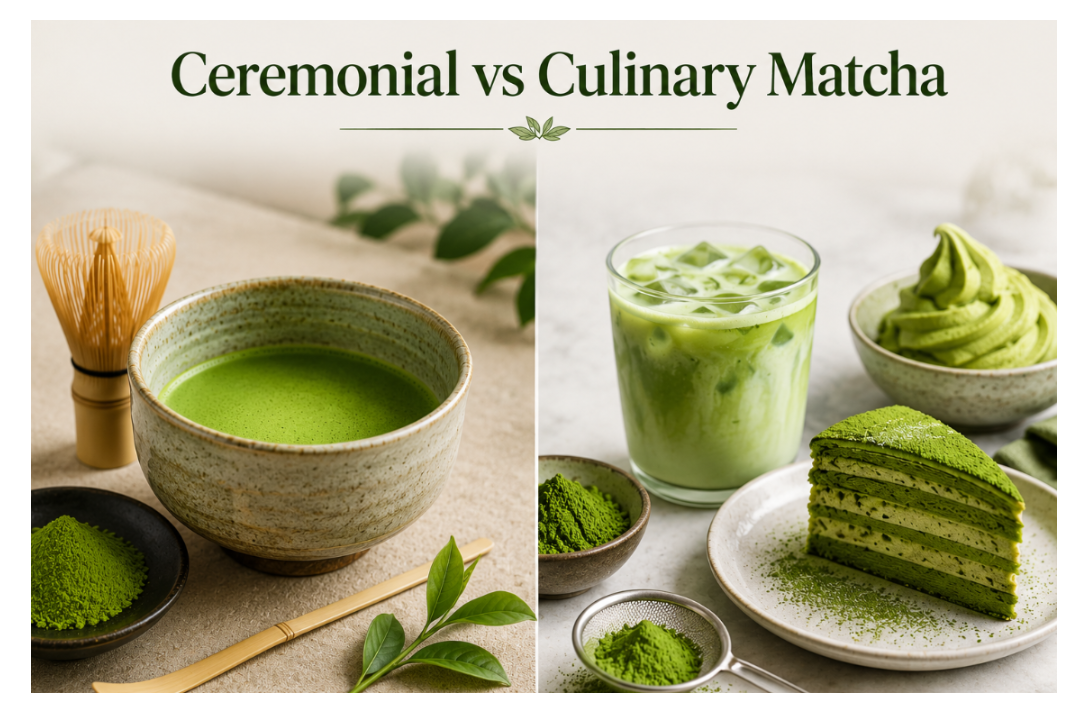
The short answer
Ceremonial grade is made from the youngest, first harvest leaves, stone ground slowly, and it is smooth enough to drink on its own. Culinary grade comes from later harvests and is sharper and more bitter on purpose, so it can cut through sugar in baking. Drinking it? Ceremonial. Baking it into something sweet? Culinary is fine and cheaper.
Walk into any shop and you will see two words on matcha tins: ceremonial and culinary. Most people assume one is the good stuff and one is the cheap stuff, buy the expensive one, and hope for the best. That is roughly right, but it misses the part that actually matters, and it is the part almost nobody selling matcha wants to tell you.
The difference between the two grades is real. It starts in the field months before harvest and it ends in your cup. But the labels themselves are worth very little, and knowing why is the difference between paying for good matcha and paying for a good sticker.
Nobody regulates these words
There is no legal standard for ceremonial grade matcha. No governing body certifies it, in Japan or anywhere else. It is a marketing term, which means any brand can print it on any tin of any powder and sell it at a premium. The same goes for the invented middle tiers you will see, things like latte grade or premium grade, which mean whatever the seller wants them to mean that day.
So what do you trust instead?
Specifics. A real ceremonial matcha will name its region, its harvest, and how it was ground, because those things cost money and the producer wants credit for them. Uji, Kyoto. First flush. Stone ground. If a tin says ceremonial grade and nothing else, the word is doing all the work and there is nothing behind it.
Ceremonial vs culinary, side by side
Here is what genuinely separates them, from the field to the cup.
What ceremonial grade actually means
It starts with shade. For about three to four weeks before picking, the tea plants are covered. Starved of direct sun, the leaves flood themselves with chlorophyll and amino acids to keep working. That is where the vivid jade colour comes from, and where the sweetness and the savoury depth people call umami come from too.
Then only the youngest leaves of the first spring harvest are picked, the stems and veins are stripped out, and what is left is ground between granite stones. Slowly. A stone mill produces only about thirty to forty grams an hour, because going faster generates heat, and heat cooks the flavour out before it ever reaches you. That is why a good tin costs what it costs. You are paying for shade, for time, and for a mill that refuses to hurry.
What culinary grade actually means, and why it is not bad
Culinary matcha comes from later harvests, the second, third, or fourth picking, using more mature leaves that saw more sun. It often includes stems, and it is usually milled by machine rather than stone. The result is duller in colour, coarser in texture, and noticeably sharper and more astringent to taste.
Here is the part people get wrong: that sharpness is a feature, not a flaw. Culinary matcha is built to survive being baked into a cookie or blended into a smoothie with a pile of sugar and butter. It has to be loud, or it disappears. If you put ceremonial matcha in a brownie, all the nuance you paid for gets bulldozed and you have essentially set money on fire. Right grade, right job.
How to tell them apart yourself
Since the label cannot be trusted, learn to read the powder. These five checks take about a minute and no equipment.
-
Look at the colour
Real ceremonial matcha is a vivid, almost electric jade green. If it looks olive, khaki, yellowish, or army green, it is either culinary grade, oxidised from age, or both. This one check catches most of it.
-
Rub it between your fingers
Ceremonial matcha feels like talc or eyeshadow, so fine it almost feels wet, and it will stain your fingertips green. Culinary feels sandy and grainy, because it was milled fast rather than stone ground.
-
Smell it
Open the tin and put your nose in it. Good matcha smells sweet and fresh, green in a way that is closer to fresh grass than dried leaves. Culinary and stale matcha smell flat, dusty, or like hay.
-
Taste it in water alone
This is the honest test. Whisk it with water only, no milk, no sugar. If you can happily drink it, it is ceremonial. If you flinch, it is culinary, and no amount of oat milk will change what it is, it will only hide it.
-
Read what the label does not say
Look for three specifics: the region, the harvest, and the grind. Uji, Kyoto. First flush. Stone ground. If a tin only says ceremonial grade and Japan, the vagueness is deliberate. Real producers name things.
What it should actually cost
Price is the fastest lie detector you have. Real ceremonial matcha usually lands somewhere around a dollar to three dollars per gram, so a 30g tin sitting roughly in the twenty five to forty dollar range is normal and honest. Culinary grade runs far cheaper per gram, because everything that makes it cheaper is upstream in the field.
So when you see a 100g bag labelled ceremonial grade for fifteen dollars, you are not finding a bargain, you are looking at culinary matcha wearing a nicer word. Nobody shades a field for a month, hand picks the first flush, and stone grinds it at forty grams an hour to sell it to you for fifteen cents a gram. The maths simply does not work.
So which one should you buy?
It depends entirely on what you are going to do with it. Here is the honest breakdown.
Drinking it straight
No debate here. Whisked with just water, there is nowhere for a bad matcha to hide. This is the whole reason ceremonial grade exists.
Matcha lattes
The question we get most. A good culinary grade will technically work, but you will find yourself adding sugar to cover the bitterness. Ceremonial needs less sweetener because it is already sweet, so you taste matcha instead of syrup.
Baking and smoothies
Use culinary and spend the savings elsewhere. Sugar, butter, and banana will flatten every subtle note you paid extra for, and culinary is loud enough to still taste like matcha at the other end.
Gifting
Nobody has ever been delighted by a bag of powder. A sealed tin of first flush from a named region is a real gift, and it survives being opened in front of people.
Ceremonial, and we will show our work
Koharu is first flush, stone ground in Uji, Kyoto, and sealed in a 30g tin. Region, harvest, and grind, on the label, because those are the only things that mean anything. It is also the exact matcha we pour at every Pour & Pulse event.
Shop Koharu MatchaCommon questions
If you are drinking it, yes. The price gap comes from real costs: shading the field for weeks, hand picking the first harvest, and stone grinding at about forty grams an hour. If you are baking with it, no, culinary grade is the smarter buy and you will not taste the difference under sugar.
You can, and plenty of cafes do. It will taste sharper and you will need more sweetener to balance it. That is the trade. If your matcha lattes have always tasted bitter, the grade is usually the reason.
No. There is no legal or official standard for the term anywhere, including Japan. Any seller can print it on any tin. That is why region, harvest, and grind matter more than the word itself.
Marketing. Since none of the grade names are regulated, sellers invent middle tiers freely. Ignore the tier name and look at the specifics on the label instead.
Usually your water was too hot, or the matcha is old. Use water at about 175F rather than boiling, and remember matcha is a fresh food that fades within weeks of opening. If it is vivid and fresh and you brewed it cool, it should not be bitter.
Slightly, since younger shaded leaves hold more. But it is a small difference, and both grades give the steady lift matcha is known for rather than the spike of coffee.
Sealed, cold, and dark. Air, heat, and light are what turn vivid green into dull and sweet into bitter. A sealed tin in the fridge is ideal, and buy smaller amounts more often rather than one big bag.